

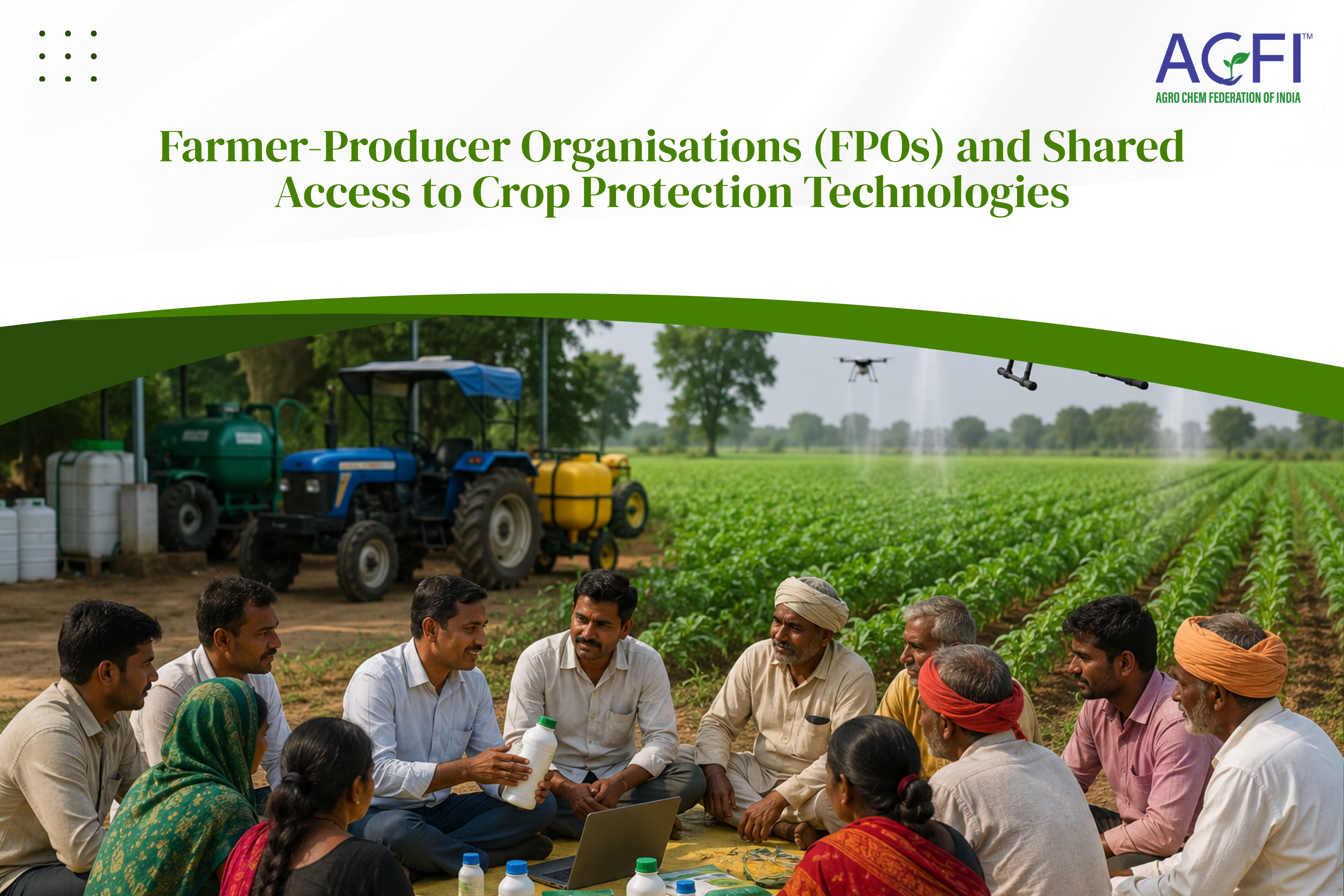
Farmer-Producer Organisations (FPOs) and Shared Access to Crop Protection Technologies
Over 10,000 Farmer-Producer Organisations (FPOs) are actively redefining the future of Indian agriculture, turning individual, fragmented farmers into a powerful collective force. These institutions are breaking the cycle of high-input costs by reducing expenses by 20-30% while pioneering the adoption of advanced, sustainable agricultural technologies, bringing prosperity to marginal farmers nationwide.
Strategic Technology Access
FPOs facilitate bulk procurement of quality agrochemicals, including bio-pesticides, nano-formulations, and precision herbicides, eliminating intermediaries' markups of up to 40%. Shared infrastructure, community drones, mechanised sprayers, and soil testing labs ensure uniform application across large areas, cutting chemical usage by 25% while minimising environmental drift. Training programs emphasise Integrated Pest Management (IPM), equipping members with pheromone traps, digital advisories, and weather-linked protocols via platforms like Kisan Suvidha.
In regions like Maharashtra's vineyards and Uttar Pradesh's wheat belts, FPOs coordinate post-harvest treatments and certified seeds, slashing rejections from 15% to under 5% and enhancing market premiums.
Collaborative Solutions to Counter the Challenges
Capital constraints and technical know-how gaps hinder individual farmers, but FPOs leverage NABARD (National Bank for Agriculture and Rural Development) financing. Government grants up to ₹15 lakh per organisation, and industry partnerships for equipment subsidies. Demo plots substantiate tangible returns, achieving 10-15% income growth via resilient yields and integration with PMFBY insurance schemes. Digital tools track residue limits (MRLs) and connect produce to export chains.
Internal coordination issues are mitigated through federations and extension services, fostering equitable tech-dissemination.
Conclusion
FPOs redefine crop protection by pooling resources to drive shared innovation and empower marginal farmers through economies of scale and expertise. This model not only curbs losses but also builds climate-resilient farming systems, securing long-term prosperity across India's diverse agri-regions.